
EX Dragon Frontiers Set Guide
Released November 8, 2006 — the last stand of Delta Species, two Gold Stars that still command serious money, and a Dragon-themed island world unlike anything before or since in the EX era.

Checking In From the Farm…
EX Dragon Frontiers does not get talked about nearly enough. It sits at the very end of the EX era, right before Diamond & Pearl took over, and because of that it sometimes gets overlooked as “just another late set.” That is a mistake. Dragon Frontiers has one of the most distinctive identities of any EX-era set: a remote island chain where Delta Species Pokémon are completely natural, almost no non-delta Pokémon, and two Gold Star pulls — Charizard and Mew — that are among the most sought-after cards of the entire era.
The English set released on November 8, 2006, with the Japanese version, Offense and Defense of the Furthest Ends, arriving earlier on June 29, 2006. It is the 15th main expansion of the EX Series, contains 101 cards, and was the final EX-era set to feature Delta Species Pokémon. After this, the Delta Species concept was retired permanently.
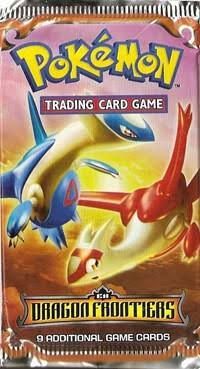
EX Dragon Frontiers Booster Pack
What Was Going On With Pokémon? The Full Picture
The Video Games
This is where it gets really interesting. EX Dragon Frontiers released in November 2006, and just weeks before — on September 28, 2006 — Pokémon Diamond and Pearl launched in Japan on the Nintendo DS. The franchise was at a genuine turning point. Players on one hand were still wrapping up Pokémon Emerald, FireRed, and LeafGreen on the Game Boy Advance, while on the other hand they were getting their first taste of full 3D overworld exploration, Wi-Fi battles, and a whole new region called Sinnoh. Diamond and Pearl became the fastest-selling Nintendo DS game in Japan up to that point, selling five million copies in just a few months. The energy shift was real — a new generation was arriving, and the GBA era was closing. Dragon Frontiers landed right in the middle of that transition.
The Anime
In the fall of 2006, the English dub of the anime was finishing up Pokémon: Battle Frontier — the ninth season, which aired on Cartoon Network from September 2006 through March 2007. Ash was traveling through Kanto, challenging the Battle Frontier’s seven Frontier Brains and collecting Frontier Symbols. This was also a landmark moment behind the scenes: 4Kids Entertainment had lost its dubbing rights at the start of 2006, and Pokémon USA took over — bringing noticeable changes to voice acting and music that many fans of the era still remember. Meanwhile in Japan, the Diamond and Pearl anime launched on September 28, 2006 — the same day as the games — with Ash heading to Sinnoh alongside new companion Dawn. The franchise was changing fast, and Dragon Frontiers was releasing right as that shift happened.
The TCG at the Time
The Pokémon TCG was deep in the Pokémon-ex era, where knocking out a Pokémon-ex gave your opponent two Prize cards instead of one. This created a calculated, risk-reward style of gameplay very different from modern formats. Crystal Guardians had just released in August 2006, and Dragon Frontiers followed in November as the penultimate EX-era set — EX Power Keepers in February 2007 would be the last before Diamond & Pearl cards arrived in May 2007. Dragon Frontiers was also the most focused Delta Species set ever made: nearly the entire Pokémon lineup was Delta Species, with only four non-delta Pokémon in the whole set. No dual typing either — each card had a single shifted type, keeping the concept clean and cohesive.
Charizard Gold Star: The Crown Jewel
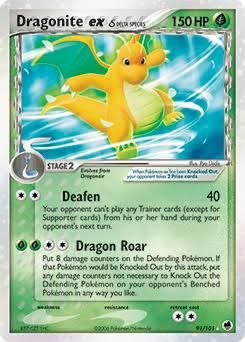
Dragonite ex (delta species) #91
There is no conversation about EX Dragon Frontiers that does not start with Charizard Gold Star #100. It is one of the most valuable Charizard cards ever made and the undisputed chase card of this entire set. The artwork shows a black and silver shiny Charizard — the delta coloring — with that unmistakable gold star symbol that collectors have chased since the Gold Star mechanic began in EX Team Rocket Returns.
On the current market, even heavily played and low-grade PSA copies are commanding serious money. A PSA 1 recently sold for around $1,925 raw on eBay, with asking prices for PSA 1s around $3,500. The PSA population for this card shows over 4,600 total graded copies, with the PSA 1 grade alone accounting for nearly 700 — which tells you just how many beat-up copies exist, and how hard a clean copy truly is to find. NM raw and mid-grade copies regularly sell in the several-hundred-dollar range, and high-grade PSA 9 and PSA 10 examples reach well into the thousands. This card is a legitimate grail.

🐣 Torchic Says…
“Charizard Gold Star is expensive because collectors still desperately want it AND clean copies are genuinely rare. That combination does not go away. High-grade copies of this card have a long ceiling.”
Rayquaza ex (delta species): The Other Big Name
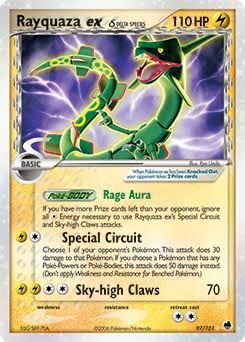
Rayquaza ex (delta species) #97
Rayquaza ex #97 is the set’s most visually striking non-Gold-Star card. The delta coloring shifts Rayquaza into a blue and silver palette, and it carries that massive EX-era silver border energy that collectors are increasingly paying attention to. Rayquaza has always been a fan favorite, and the combination of the ex mechanic, the delta species type shift, and the striking alternate color scheme makes this one genuinely desirable.
Raw NM copies have been selling in the $70–$100+ range on the secondary market depending on condition, with graded examples going higher. A PSA 10 of this card sold for the equivalent of well over $2,800 in a recent European eBay sale. For collectors who missed Charizard Gold Star’s price run, Rayquaza ex delta is worth watching — it has strong popular appeal with a comparatively lower entry point on raw copies.
Mew Gold Star: The Other Grail
Mew Gold Star #101 is the second Gold Star in this set and arguably the most beautiful card in it. The artwork shows a baby-blue Mew with a stark red-and-white background — a striking, minimal composition that photographs incredibly well. Mew’s status as a Mythical Pokémon gives it cross-generational collector appeal that Charizard itself sometimes cannot match with certain audiences.
The price data on Mew Star tells a story of genuine scarcity. Even heavily played copies have sold in the $350–$450 range, with LP sales around $500. NM copies are rare enough on the market that pricing is still heavily influenced by whenever one surfaces. This is a card where condition truly dictates value — the gap between a played copy and a near-mint copy is enormous.
Latias ex (delta species): The Underrated Play
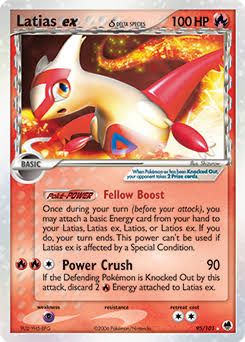
Latias ex (delta species) #95
Latias ex #95 — and its partner Latios ex #96 — are exactly the kind of cards I watch for on the finance side. Latias and Latios have a dedicated collector base who want both cards together, which creates consistent demand. The delta species artwork gives them shifted typing and a different look than their other ex versions, and the silver border EX treatment makes them feel premium. Raw NM copies of Latias ex are currently sitting in the $90–$135 range on TCGplayer, with eBay sometimes running a bit higher depending on seller. That is an accessible entry point for a Legendary Pokémon ex from the last EX-era set that featured Delta Species. I think there is room for continued appreciation here, especially as the EX-era collector audience grows.
Other ex cards worth watching in this set include Dragonite ex, Salamence ex, Flygon ex, and Tyranitar ex — all carry popular Pokémon names, all have delta coloring, and all are from a set that will never be reprinted in this format. The ex cards in Dragon Frontiers tend to run in the $70–$191 range for NM raw copies depending on the specific Pokémon, which makes them reasonable targets for patient collectors building toward a master set.
A Finance Note: TCGplayer vs. eBay
One thing I always tell collectors is to check both platforms before buying or selling Dragon Frontiers cards. TCGplayer is great for getting a market-price baseline on raw singles — their market price averages out recent sales and gives you a realistic number. eBay, however, often reflects a slight premium for higher-condition copies and graded cards, since the auction format can drive prices above market when multiple motivated buyers compete. For bulk pickups and completing a set on a budget, TCGplayer tends to win. For individual high-condition copies, eBay is where you often find the real ceiling. Always cross-reference both before pulling the trigger on anything significant from this set.
Sealed Product Today
Sealed Dragon Frontiers product is genuinely scarce. The set was released in late 2006 and has been out of print for nearly two decades. What you might still encounter:
- Loose booster packs — the most accessible sealed option, but buyer beware: older EX-era packs are frequently weighed, searched, or resealed. Only buy from trusted sources, and ideally graded sealed packs from a reputable grading company.
- Booster boxes — extremely rare. When they surface, they command very high prices. Do not expect to find one at retail-adjacent pricing.
- Theme decks — the Power Wave and Shadow Blaze theme decks occasionally surface and represent a lower-cost sealed option, though they contain fixed cards and have limited pull value.
- Graded sealed packs — increasingly the safest way to hold sealed product from this era as a collector piece.
If you are chasing sealed product from Dragon Frontiers as a long-term hold, patience and verification are everything. Booster boxes from the late EX era, when they do sell, have historically reflected significant collector premiums.
Cards I Would Watch
- Charizard Gold Star #100 — the undisputed grail. High-grade copies have a long ceiling.
- Mew Gold Star #101 — Mythical status, beautiful art, genuine scarcity. NM copies are rare.
- Rayquaza ex (delta species) #97 — popular Pokémon, striking delta coloring, strong graded sales history.
- Latias ex + Latios ex combo — accessible entry, paired collector demand, Legendary appeal.
- Dragonite ex (delta species) #91 — beloved Pokémon, late EX era, delta type shift.
- Tyranitar ex (delta species) #99 — strong fanbase, dramatic artwork, under-discussed for this set.
- Stamped delta species reverse holos — master set builders and binder collectors chase the full run. Condition is everything on these.
Grading Thoughts
EX Dragon Frontiers presents the same grading challenges as any late EX-era set. The silver borders show edge whitening and handling marks quickly. Holo surfaces on the ex cards and Gold Stars scratch easily — many of these were opened by kids in 2006 without sleeves anywhere near them. Even cards that look acceptable in a binder often come back as PSA 7 or lower once the corners and edges get examined closely.
That gap between a raw “good looking” copy and a PSA 9 is exactly where the value lives in this set. If you are pulling cards for personal collection, raw is fine. If you have a copy of Charizard Gold Star or Mew Gold Star that genuinely looks clean, it is absolutely worth getting graded before selling — the premium over raw is substantial, and the population data on high-grade copies is low enough to matter.
Subscriber Checklist Access
I have built a downloadable master set checklist for EX Dragon Frontiers — all 101 cards, with columns for regular, holo, reverse holo, and personal condition notes. It is part of my growing PokeFarm TCG checklist library available to subscribers.
Subscribe & Unlock the Checklist Library
Subscribers get access to my growing checklist archive — including the EX Dragon Frontiers master set checklist — plus future subscriber-only coupon codes for my eBay store.
Shop & Follow PokeFarm TCG
Follow @pokefarmtcg on Instagram for pickups, vintage cards, restoration tests, checklist updates, and set guide posts.
You can also shop from me through eBay and my TCGplayer Pro shop, where I aim to price cards around 5% below market value whenever possible.
Final Thoughts
EX Dragon Frontiers is the end of an era in the most literal sense — the last Delta Species set, the last true EX-era set before Diamond & Pearl began, and one of only a handful of sets that contains two Gold Stars. The Charizard and Mew Gold Stars are legitimate long-term collector targets. The ex cards — especially Rayquaza, Latias, Latios, and Dragonite — have strong fundamentals and names that collectors keep coming back to. And the set’s tight focus on a dragon island full of Delta Species gives it an identity that is genuinely unique in the history of the Pokémon TCG.
For master set builders, this one is a challenge and a joy. For finance-minded collectors, there are real plays here at multiple price points. Either way — Dragon Frontiers deserves more attention than it gets.
